
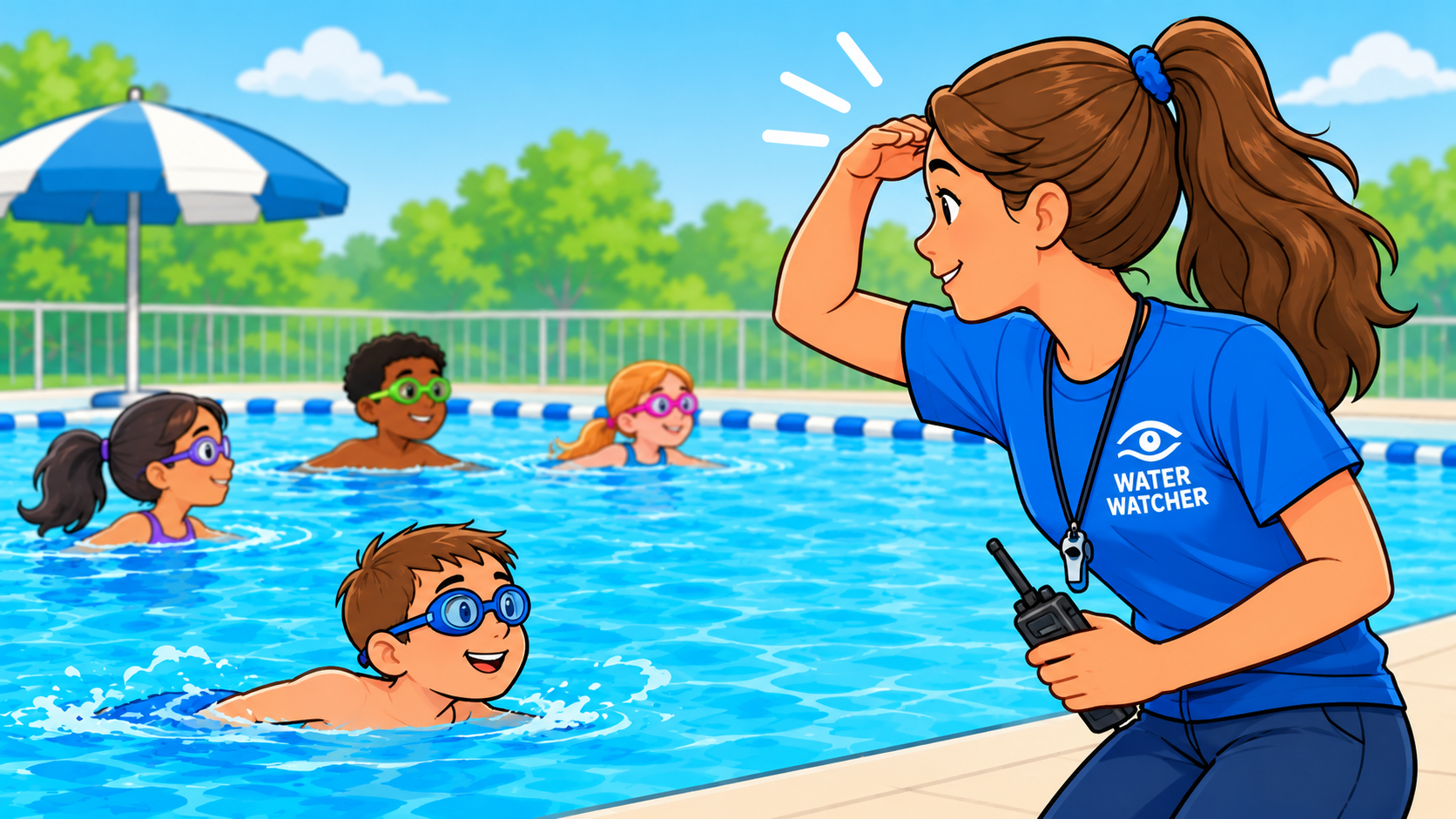
If you run a summer camp or direct an aquatics program, you know the picture at free swim: a pool full of campers, a few lifeguards in the chairs, and a dozen counselors standing on the deck. Those counselors are a safety resource you’re already paying for. With 45 minutes of Water Watcher training, they go from bystanders to someone who can help supplement your lifeguards.
Why every extra set of trained eyes matters
Drowning is the leading cause of death for children ages 1 to 4 and the second leading cause of injury-related death for children 1 to 14. Most drownings happen when supervision is missing or interrupted.
It also happens fast. An infant in trouble can lose consciousness in as little as 20 seconds; an adult may struggle for about a minute. And a child who is actively drowning usually can’t call for help. Arms push down at the sides, the body stays upright, and there’s no forward progress. To an untrained eye, it can look like play.
Your lifeguards are trained to catch it. The question for directors is how many other people on your deck can, too.
A supplement, not a substitute
Let’s be clear up front: Water Watchers do not replace lifeguards. If your camp pool is required to have lifeguards, it still needs them. Lifeguards complete roughly 25 to 30 hours of training and must prove they can perform water rescues, CPR, and first aid. The Water Watcher course is 45 minutes of basic information with no skills test.
What Water Watcher training does is turn the camp counselors and other staff already around the pool into active supervisors who know what to look for. Counselors who complete it can:
- Recognize the difference between a normal swimmer, a distressed swimmer, and an active or passive drowning victim
- Scan the water the right way, including the bottom of the pool
- Signal a lifeguard immediately and activate the camp’s emergency action plan
- Help enforce pool rules and stop risky behavior before it becomes an emergency
- Help a struggling swimmer reach the wall with a noodle, rescue tube, or reaching pole, when they’re trained, willing, and equipped to do so
A lifeguard’s chair gives one view of the water. A trained counselor on the deck gives another.
What directors gain by training counselors
More supervision, no new hires. Your counselors already walk their groups to swim every day. Training them adds a layer of supervision without adding to your payroll or your lifeguard schedule.
They know the kids. A counselor knows which camper is a weak swimmer, which one gets overconfident, and which one has been tired all week. That kind of knowledge helps with the hardest part of surveillance: noticing when something is off.
More eyes means smaller zones. Crowded pools make struggling swimmers harder to spot, especially when a group of similar-looking kids is playing together. Water Watchers can be assigned specific areas so lifeguards aren’t scanning the whole pool alone.
They fix the RID factor. Most missed emergencies come down to Recognition, Intrusion, or Distraction. Training teaches counselors what drowning actually looks like and why the person watching the water shouldn’t also be refereeing games, handing out snacks, or checking a phone.
They free lifeguards to guard. Counselors handling rule reminders, life jacket checks, and camper questions means lifeguards can keep their eyes on the water.
It fits into orientation week. The course takes about 45 minutes, has no prerequisites, and is suggested for anyone 15 and older, so junior counselors can take it too. Each participant gets a certificate for your training records.
Better reporting after an incident. Water Watchers learn to document only what they saw, without guessing at causes. That gives you cleaner incident reports when you have to review an event with your leadership, insurer, or first responders.
It builds a culture of safety. Counselors who understand Layers of Protection and the basics of an emergency action plan bring that awareness to the lake, the splash pad, and every trip near water.
Putting it into practice at your camp
- Add the course to staff orientation. Have every counselor complete it before the first swim day, and print the certificate of participation for your records.
- Assign clear zones. Give each Water Watcher a defined area to scan, and add more Water Watchers as the pool gets crowded.
- Make them identifiable. A Water Watcher tag tells campers who’s on duty and reminds the counselor wearing it to keep watching.
- Keep their job single-purpose. While on watch, a counselor watches. Someone else handles snacks, sunscreen, and towels.
- Rotate without gaps. Relieve Water Watchers at least once an hour. The incoming counselor starts scanning before the outgoing one steps away, and they pass along notes, like which camper is struggling today.
- Tie them into your emergency plan. Every counselor should know the camp’s signals, how to alert a lifeguard, and when to call 911.
- Encourage more training. First aid and CPR (with rescue breaths, not hands-only) make a Water Watcher even more valuable.
Before expanding roles, check with your insurance carrier and legal counsel about how volunteer or staff Water Watchers are covered at your facility.
Every layer counts
No single measure prevents drowning. Barriers, swim lessons, life jackets, emergency preparation, and supervision all work together. Lifeguards are the backbone of supervision at camp. Trained counselors make that layer stronger.
Any layer of protection is better than no layer of protection. As you plan staff training for next summer, give your counselors 45 minutes, and give your lifeguards backup that knows what to look for.
Ready to add Water Watcher training to your staff orientation?