
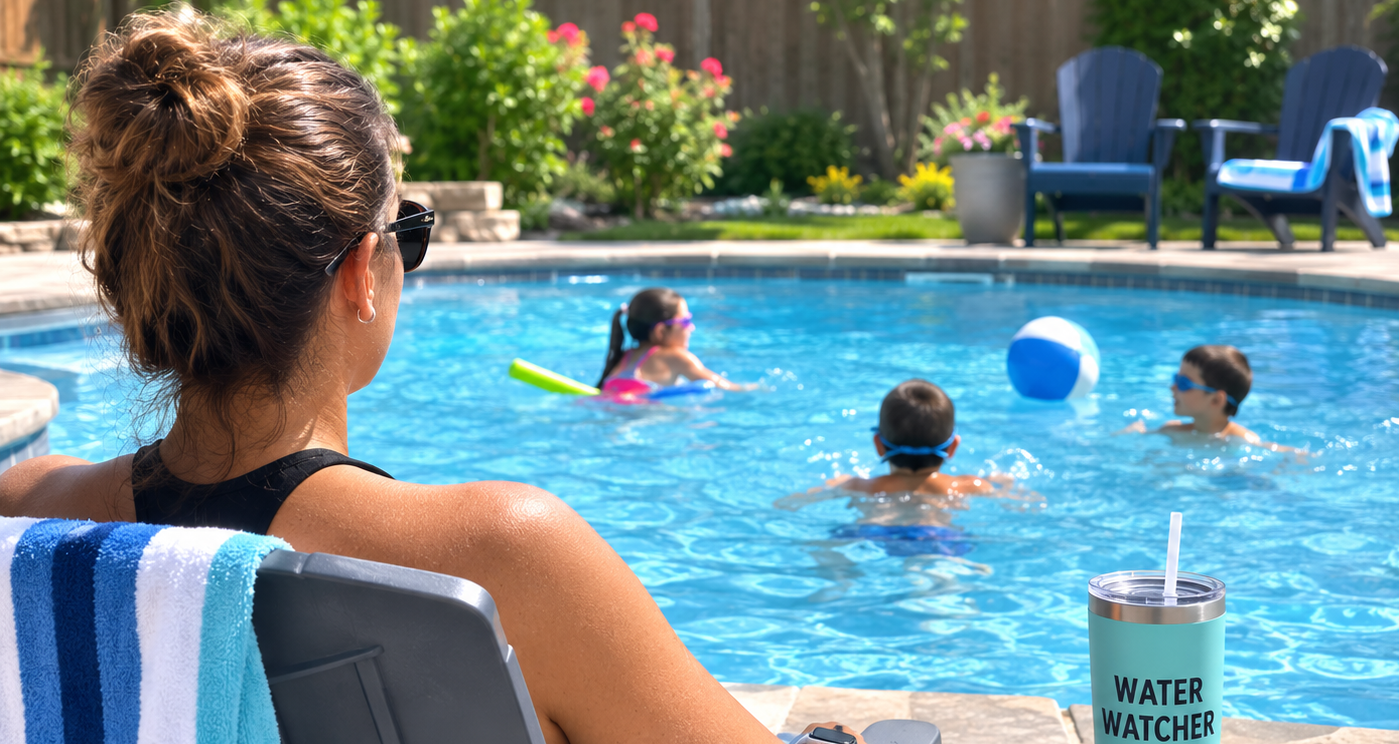
Drowning remains the leading cause of death for children ages 1 to 4 in the United States, and it’s the second leading cause of unintentional injury death for kids ages 5 to 14. What makes these numbers so hard to sit with isn’t just their scale — it’s how often they happen close to someone who loves that child. Nearly 70% of fatal child drownings involve a parent who was present at the time. Drowning doesn’t look like the movies. In many cases, there is no splashing, no shouting, no waving for help. It happens in seconds, and it’s almost always silent.
That single fact is why supervision sits at the center of every serious drowning prevention strategy. Fences, life jackets, and swim lessons all matter enormously, but none of them replace a dedicated set of eyes on the water.
Why “someone was watching” isn’t the same as supervision
One of the most sobering patterns in drowning data is how often it happens when multiple adults are nearby. At a pool party, a barbecue, or a family gathering, everyone assumes someone else has eyes on the kids. That assumption is exactly the gap drowning slips through. Diffused responsibility isn’t supervision — it’s the absence of it wearing a disguise.
Real supervision has a few non-negotiable qualities:
- Undivided attention. No phone, no book, no conversation that pulls your eyes away, no alcohol.
- Proximity. For young children and weak swimmers, that means being within arm’s reach — close enough to physically grab them, not just close enough to see them.
- Continuity. Supervision that stops the moment a child leaves the water isn’t enough. Most toddler drownings actually happen during non-swim time, when a child wanders back to a pool, pond, or bathtub unnoticed.
- A named person. If supervision duty isn’t explicitly assigned to one adult, it isn’t assigned to anyone.
Use a Water Watcher
Water safety organizations increasingly recommend a formal Water Watcher system for any gathering near water. The idea is simple but effective: designate one sober adult whose only job — for a set period of time — is watching the water. Not chatting, not grilling, not half-watching while scrolling a phone.
A few practical ways to make this work:
- Use a physical marker — a card, a lanyard, even a specific hat — that gets handed off when the Water Watcher role changes hands, so it’s always obvious who’s on duty.
- Rotate the role every 15–20 minutes. Sustained, focused attention is hard to maintain longer than that, and a tired watcher is a distracted one.
- Treat the handoff like a relay baton — the outgoing watcher confirms out loud that the incoming one is ready before stepping away.
This structure removes the ambiguity that “everyone’s watching” creates and replaces it with clear, single-point accountability.
Supervision by age and setting
Supervision needs aren’t one-size-fits-all. What’s appropriate shifts as children grow, and different water environments carry different risks.
Infants and toddlers (under 5): This is the highest-risk group, and the standard is the strictest — touch supervision, meaning an adult is within arm’s reach at all times in or near water, including bathtubs, buckets, and kiddie pools. Most drownings in this age group happen in home swimming pools, and a large share happen when a child gains access to water during a moment nobody expected them to be near it.
School-age children (5–14): Even after swim lessons, this group still needs close, constant supervision — a lifeguard on duty doesn’t change that. Roughly 40% of drownings in this age range happen in natural water like lakes and rivers, where currents, drop-offs, and murky water add risks a backyard pool doesn’t have.
Teens and adults: Supervision shifts toward the buddy system, along with awareness of alcohol’s role — most adult and teen drownings involve natural water, and impaired judgment or fatigue plays a outsized role in how they happen.
People with medical risk factors: Anyone with a seizure disorder or a condition that could cause sudden incapacitation in water needs one-on-one, uninterrupted supervision, not the general standard.
Supervision works best as one layer, not the only layer
No single safeguard fully closes the risk of drowning on its own — including supervision. That’s why prevention specialists talk about “layers of protection”: supervision, four-sided pool fencing with a self-latching gate, swim lessons, life jackets in open water, and CPR knowledge, all stacked together. Each layer catches what the others might miss. A distracted moment is covered by a locked gate; a fence left open is covered by a watchful adult; a close call is covered by a bystander who knows CPR.
Thinking of supervision as one link in that chain — rather than a single line of defense — keeps expectations realistic. Even the most attentive parent can look away for a few seconds. The goal isn’t perfect vigilance; it’s building a system where a lapse in one layer doesn’t turn into a tragedy.
A few habits worth adopting today
- Assign a named Water Watcher any time children are in or near water, and rotate the role.
- Keep young children within arm’s reach in and around any water, including the bathtub.
- Empty buckets, kiddie pools, and bathtubs immediately after use — a child can drown in just a few inches of water.
- Lock gates and doors that lead to pools as soon as swim time ends.
- Learn to recognize what real drowning looks like: a quiet child low in the water, head tilted back, arms pressing down rather than waving.
- Get CPR certified. In the minutes before help arrives, that knowledge can be the difference that matters most.
Drowning prevention isn’t about eliminating water from a child’s life — it’s about making sure that whenever they’re near it, someone is truly, actively watching. That si
Ready to put this into practice?
Knowing that supervision matters is one thing — knowing exactly how to do it well is another. Our Water Watcher Training course walks you through everything covered here in hands-on detail: how to spot the real signs of drowning before they escalate, how to run a Water Watcher rotation at a pool party or family gathering, what “arm’s reach” supervision actually looks like for different ages, and how to respond in the critical first moments of an emergency. Whether you’re a parent, a grandparent, a camp counselor, or someone who just wants to be the confident adult in the room the next time you’re near water, this course gives you the skills to make supervision second nature. Sign up for our Water Watcher Training course and take the next step toward being the kind of watcher who catches trouble before it starts.